
Practicing Ethnography – What They Don’t Tell Us
Merlyn Maria Antony
Doctoral Candidate, School of Human Ecology,
Dr. B.R. Ambedkar University Delhi, India
12 January 2025 – I was okay until mass at Stella Maris Church in Prem Nagar at 4 pm. The drowsiness I felt at the beginning of the service gave way to sadness during the communion as tears rolled down. And since then, it is 7 pm now, I have been feeling sad. I scrolled on my phone, but that also has not helped. I thought I’ll read the Bible and write my diary later at night, and in the meanwhile read an academic text. But then I thought of Malinowski’s diary, which led me to write mine. I am feeling sad. I feel lost. I feel alone. I want to return to the familiar, where there are people I can talk to. I feel overwhelmed thinking of things to come. I am tired. The cost of living makes me cry. I just long to go back. And today is only the fourth day.
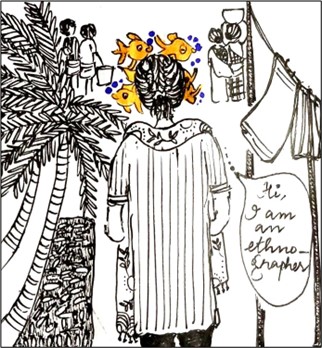
Finding it difficult to live in a fishing household, Cecelia Busby (2000) in her book mentions that she booked tickets for home and left. It was during this time before she returned to the field that she came across Malinowski’s (1989) diary, which she recommends to everyone working in a ‘field’. In my doctoral research, I practice ethnography to understand the fish economy in the Andaman Islands. I rely on participant observation using the lens of political economy and economic anthropology to understand the making of a fish economy. I have been living in the Andaman Islands since January 2025. Because of the intimacy that fishing shares with seasons, I have chosen to spend one calendar year on the islands. The above is an excerpt from my diary from the early days of my fieldwork when I was yet to decide the settlement that I was going to study. This is my first attempt at practicing ethnography. Maybe because of this, I was not prepared for the emotional, personal, and practical challenges that awaited me.
In the ethnographies I had read until now, the authors came across as researchers in absolute control of their discipline and field. Their lucid writings from which I attempted to glean the human behind the research, came across to be anything but me, what I was feeling in my field. My professors at university had often spoken about positionality and reflexivity, but in the field, none of that answered my vexations. I questioned my temperament to be an ethnographer. I wondered if there should be a psychology test to determine if someone is fit to be an ethnographer. Would conducting a survey have been easier? Malinowski’s posthumously published diary came as a respite in this despair. His entry from 27 September 1914 reads, “… Insomnia (not too marked), overtaxed heart, and nervousness (especially) seem so far the symptoms”.
2 February 2025 – I have been unwell today. Felt feverish. Self-medicated on two doses of over-the-counter medications, once in the afternoon, and once after dinner. I do not want to be here. I do not see myself spending days/months/years in the Islands. I feel I am in the wrong line of work. I have not been reading. I am mostly tired. I am homesick and only dream of returning home. I think the desire to keep eating also stems from there. Just to eat and sleep. Malinowski would have wanted to read novels, but I just want to stare at my screen.
Under the subsection “The Power of the Researcher” in her book, Baviskar (1999) writes about her privilege in contra to the material poverty of her participants which segues into a commentary on the power hierarchy manifested in the distinct class positions occupied by the researcher and the participants, and the derived mobility and freedom for one and the lack of it for the other. In a class for Methods at my university, a professor remarked that it is because we are privileged, we undertake research. We are paid for reading and writing. Going into the fieldwork stage of my research, I was well aware of my privilege as an urban educated, upper class and caste, which in academia is termed “positionality” – the researcher’s position. I was taught to be reflexive – glean the ways my position was influencing my seeing, the information I was gathering, and ultimately the ‘knowledge’ I was intending to produce by the end of my doctoral research. But this did not comfort me.
15 March 2025 – I dreamed of filling water at night. (The water in the basti (settlement) is supplied through pipelines laid in the lanes from which tubes have to be attached to route the water towards houses where they are to be stored in containers until the next supply. In months without rain, such as in March, water is supplied every sixth or tenth day.) I woke up imagining someone knocking on my door, calling my attention to the water supply. I have been awake since 3:30 am, although I did try to fall asleep again, I had to get up for water at 4 am eventually. Today, water was released for a shorter time and with lesser intensity.
Positionality and reflexivity that arose as a critique of positivist social science to elucidate the situatedness of knowledge assumes that a researcher is able to completely understand their position as a researcher and relationships to the field. However, as Frosh and Baraitser write, as cited in Proudfoot (2015), “declarations of relatively explicit aspects of the researcher’s persona will… never be complete enough to understand what her or his contribution to the research might be”. Primarily because the researcher’s understanding of self as a researcher remains partial. So not only is the knowledge created partial, rather our comprehension of this partiality is also partial (Proudfoot, 2015).
14 April 2025 – While sitting with fisherwomen in the morning, waiting for an opportune moment to join the conversation, one of them asked why I was not writing and asking them questions. This became an opportune moment. I am unable, most times, to get over the feeling that I occupy too much space. After the fish arrive, I am called to help with the gas cylinders that have made a stop a few kilometres away. I spend most of my morning with Yeramma descaling fish for drying. After lunch, crossing Nagavani’s lane to go to my house, I see her still cleaning fish along with her family members. They kept saying how much still was left to do. I felt they were asking for my help. Tired from not having slept well last night and crouching for cleaning fish most of the morning, I did not offer help. I returned to my room and slept for an hour. Nowadays, I just want to sleep and not wake up. As if there’s never enough sleep.
Universities often designate a specific period for the fieldwork phase in doctoral research, after all, there is a degree at stake. A degree can often become a testing ground for researchers if they fit the academic professional standards. But as geographers such as Wilmark et al. (2017) working with emotions of the self, write, “While the field can be imagined as a place free from social relations ‘back home’, they nevertheless travel with the researcher into the field. The researcher must navigate these ‘transported’ relations alongside those forged in the field.”.
17 May 2025 – While waiting for the children whom I tutor, I spoke with my sister, consumed half a chocolate, and practiced Telugu. Only one boy showed up and requested not to study, rather suggesting we simply look at the rain pouring down the tin roof of the houses. Both of us watch the rain fill the buckets that I placed. The boy experiments with his umbrella to make the process more efficient as lightning crackles and thunder roars. The hour soon passes as we make origami cranes and play a game of chess.
Bio
Merlyn is a doctoral candidate at the School of Human Ecology at Dr. B.R. Ambedkar University Delhi, India. She attempts to use a political economy and feminist lens to look at the fish economy in the Andaman Islands. Her disciplinary training albeit have been Mathematics and Development Studies, she continues in search of her voice. Through her work she explores the nature-society binary with focus on justice. And anytime when not fussing about work, she bakes.
Acknowledgement
Thank you Rashmirekha for standing by me while I braved my vulnerabilities on Word. Thank you to the SASE India team for their edits and patience.
References
Baviskar, A. (1999). In the belly of the river: tribal conflicts over development in the Narmada Valley (pp. xiv+-286).
Busby, C. (2000). The performance of gender: an anthropology of everyday life in a South Indian fishing village. Routledge.
Malinowski, B. (1989). A Diary in the Strict Sense of the Term (Vol. 235). Stanford University Press.
Proudfoot, J. (2015). Anxiety and phantasy in the field: The position of the unconscious in ethnographic research. Environment and Planning D: Society and Space, 33(6), 1135-1152.
Wimark, T., Lewis, N. M., & Caretta, M. A. (2017). A life course approach to the field and fieldwork. Area, 49(4), 390-393.