
Navigating Access and Positionality During Fieldwork in a Government Girls’ School
Samiksha Rohilla
Ph.D. Scholar, Department of Teacher Training & Non-Formal Education (IASE) Faculty of Education, Jamia Millia Islamia
This article is a reflective piece on my ethnographic fieldwork journey in a Sarkari Girls School [Translation: Government] for my doctoral thesis on ‘Understanding the Interplay of Socio-Cultural Identities and the Processes of Schooling’. This fieldwork was conducted in the academic year 2024-25. Here, I highlight my experiences in gaining access in the field at various levels and my own positionality as a researcher.
The first time I stood outside the gate of the school, I realised that fieldwork does not begin when you are collecting data, it begins when you ask to be let in, while you are negotiating access and building trust. The depth of my data is dependent on the degree of access negotiated and trust built with both the participants as well as the immediate authorities. The formal letter did bring a sense of achievement, but my presence in the early days was met with hesitations, scepticism and guarded responses. It is through the negotiations with gatekeepers (like the Head of the School, teachers, parents, administrations, etc.) and establishing initial trust with the participants that I started to make sense of the field and could engage to know the everyday life, fears, and vulnerabilities of participants. Like any other qualitative study, my fieldwork is the foundation of my work, and the richness of my work is dependent on the depth of my fieldwork.
This school is in a densely populated ghettoised neighbourhood in Jamnapaar, Delhi.[i]The first time I was walking around the area with a university letter and research proposal in my hand, I was expecting to at least be able to talk to the HoS (Head of the School), look around and get a glimpse of the school to understand if it fits my criteria. But contrary to my expectations, I was not even allowed to enter. However, the guards of some schools were kind enough to help me understand the demography of the students coming to the school as well as the neighbourhood. But most times, I was politely told to go to the head office which was the Directorate of Education or DoE if I want to collect data for any kind of study. This was the first experience that brought me a reality check and guided me towards the formal route of sorting permissions through the DoE.
Securing Permissions and Gaining Access: The first step towards negotiating
My first step towards securing access in the field was to submit a carefully drafted permission letter to the DoE. This process became my first encounter with the power structures that shaped my initial fieldwork experience. After more than 6 months of a long tug of war between hopes and disappointments, running around to different tables in the DoE office, and almost getting rejected once, I finally secured official permission for data collection through the directorate with an exhausting list of terms and conditions.
The next day, when I entered the school with the official permission letter from the authorities, I experienced unparalleled joy and total confidence to begin my first phase of data collection. I was met with apprehension and perceived as an intruder. The school had no information about my data collection request, and I was told to come the next day while they confirmed it. This is when realisation hit me that this stamped paper just worked as my entry ‘ticket’ but did not guarantee access.
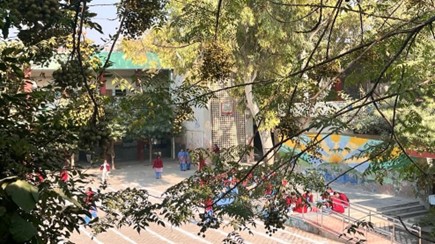
The following day, despite being allowed to sit in the classrooms for observations, there was a teacher in-charge and a separate register put in place to maintain a record of my timings and movement. The authorities seemed sceptical of what I might publish, and the teachers were cautious of my presence and unsure of my role in the school, and the students were confused about who I was – a new teacher, an intern, or some officer who has been keeping an eye on them. Access during fieldwork and even rejection of it came in different forms for me. It ranged from no access on initial days to limited access on later days or even in the form of hesitant and apprehensive participants. These apprehensions and perceptions stemmed from a place of vulnerability and fear that I could address with some transparency about my work, building trust and rapport while respecting their valid concerns. Understanding these underlying apprehensions and power dynamics during fieldwork made way for necessary negotiations and helped me make sense of a clearer picture of the field. Thus, gaining access for me was not merely a one-day event. It was a slow, ongoing process and an exercise in trust building, everyday negotiations, and sheer perseverance.
Researchers’ Positionality: Neither Insider nor Outsider
I entered the field as an urban middle class researcher (woman) coming from the privileged space of a university, carrying a letter from the authorities to interact with students whose worlds were vastly different from mine. Building trust, here, was a continuous process and came with transparency about the research intent and work, and with nearly a year-long engagement.
In the field, my identity was not just of who I was but also of how I was being perceived. With my various attempts to blend in during this journey, at times, I realised some of my mannerisms reflected that I am not from here. But, even in those moments, I was neither an insider nor outsider. I found myself constantly oscillating between this space of neither being a complete alien, nor entirely family.
The fluidity of being seen is what surprised me on most days. The school consisted of nearly 70 per cent girls from Muslim families and 30 per cent girls from Hindu families. On the very first day inside the classroom, a group of girls asked me if ‘I am a Hindu. I dodged the question to the best of my ability and regretted wearing a bindi[ii]which was pointed by a girl to confirm my religious identity. This instance stirred too many dilemmas and questions inside me, ranging from the best way to address this, whether to not respond or accept, as a researcher, I am supposed to have religion in school. and what divulging that information entail for my fieldwork. For multiple days, different students kept asking about my religious identity. When I asked why it is important, some hesitated and said it is not, while some mentioned they have never had a Muslim teacher, and they want to know if I am. Even though they knew what I was there for, and I explained to them in the simplest words what my study is about, I held the position and regard of a teacher for them.
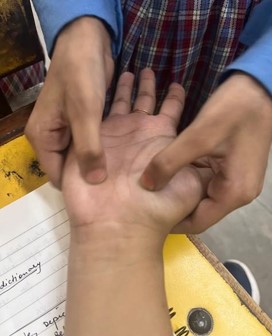
Somehow, my religious identity became an important part of their inquiry during my fieldwork. We interacted the entire academic year, told stories to each other, talked, shared jokes, laughter, problems, and sorrows, and even everyday mundane things at times. But the question of my religious identity remained constant for some months, and this curiosity remained intriguing for me as well. In the last couple of months of my field work, I started opening up bit by bit and shared thatI am not a Muslim in between interactions. To my surprise, at first, most girls refused to believe me, reasoning that I must be a Muslim because I understand their culture and even know about namaz [iii]; and eventually, leading to my religious identity not being important at all around my last week in the school. Slowly, in this journey with them, I began to realise that positionality was not a fixed identity I carried into the field, it was relational and being continuously shaped and reshaped within the context by our interactions, and each time it evolved, my access also changed with it.
I believe access and positionality were not static components during my fieldwork, but they were constantly evolving and entangled processes that shaped knowledge production during the research. The hesitations from the individuals, the restrictions set by the school and the gatekeeping from the state or authorities all had very different meanings and reasons behind them. Each of them reflected deeply inherent power dynamics in the institutional structures. While each rejection, every delay and negotiation I came across was not a mere methodological challenge but integral to making sense of the field itself. Thus, access, here, is not just a matter of sorting formal permissions to enter the field, and positionality isn’t restricted to one aspect, but both are fundamentally relational. Lastly, this complexity of gaining access, the researcher’s positionality and this ongoing dynamic between the researcher and the field echoes how knowledge produced here is mediated and embedded in the relationships that have made this fieldwork possible and practical.
Author Bio: Samiksha Rohilla is a doctoral candidate in Department of TT & NFE (IASE), Jamia Millia Islamia. She has worked as a primary teacher, teacher educator with Jodo Gyan and as a consultant with TESF – India project. Her research interests lie within the domain of education and sociology.
Endnotes
[i] East and North-East Districts of Delhi, located across the river Yamuna, are colloquially identified as Jamnapaar (across the Jamuna).
[ii] Bindi is a decorative mark, adorned on the forehead by South Asian women, mostly Hindu women in this context.
[iii] Namaz refers to the prescribed prayers in Islam.