
Dhaka, 2024: Reflections of a Researcher Amidst Crisis
Dr. Monisha Lakshminarayan
I work as a Principal Consultant with Athena Infonomics. From 2023 to early 2025, I guided a multi-country research project on a complex and sensitive human rights issue. This required me to travel to Dhaka in July 2024. I anticipated facilitating interviews with stakeholders across the ecosystem, seeking to understand how institutions, individuals, and informal networks respond to this deeply layered problem.
Dhaka greeted me with its usual energy: chaotic, vibrant, and colourful. The first few days of fieldwork followed a predictable rhythm: navigating Dhaka’s infamous traffic, facilitating and attending interviews, jotting down detailed notes, and debriefing with my colleague. Evenings were spent exploring the city and savouring ‘puchkas’.
At first, fieldwork unfolded much as it usually does on any assignment.
The City Changes
One afternoon, as we crawled through yet another traffic jam, my colleague mentioned a student protest happening nearby. “That’s probably why the traffic’s worse,” one of our field partners remarked casually. At the time, not much was made of this passing comment.
That evening, as we stepped out for tea, we watched a demonstration unfold. Students marched with placards, their chants echoing with fervour. The scene felt familiar, a kind of collective defiance that one might witness anywhere in the world. Neither of us was alarmed nor concerned.
The local news channels began reporting an impending lockdown. It appeared like a ‘bandh’ was in the offing. At face value, the response from the government appeared like an overreaction. By the next morning, our plans to travel to another city were cancelled. Still, the bustling street I saw through my hotel window reassured me with a sense of normalcy.
An Eerie Silence
But the bandh dragged on for days. At first, we tried to keep ourselves busy by transcribing interviews, reworking our data collection plans, and conducting virtual interviews. Then, the protests intensified, and our productive streak waned. By the third day, the government had shut down the internet and mobile networks, isolating us from our team, our families, and the world outside. We were confined to our rooms. My colleague and I moved into one room, seeking comfort in not being alone.
The once bustling streets, with rickshaws and street vendors, had turned barren with the occasional military patrol vehicle. From my hotel window, I watched plumes of black smoke rising at a distance. To kill time, we talked endlessly about food, politics, and books. Our only respite was the breakfast buffet, which we extended to fill the long, uneventful days.
One afternoon, as my colleague and I lingered over brunch in the hotel restaurant, the sound of gunfire erupted nearby. It was sudden, sharp, and too close. The unease I had been observing from a distance now felt terrifyingly real and close. The violence had pierced the fragile cocoon I had been trying to ensconce myself in.
The View From the Window
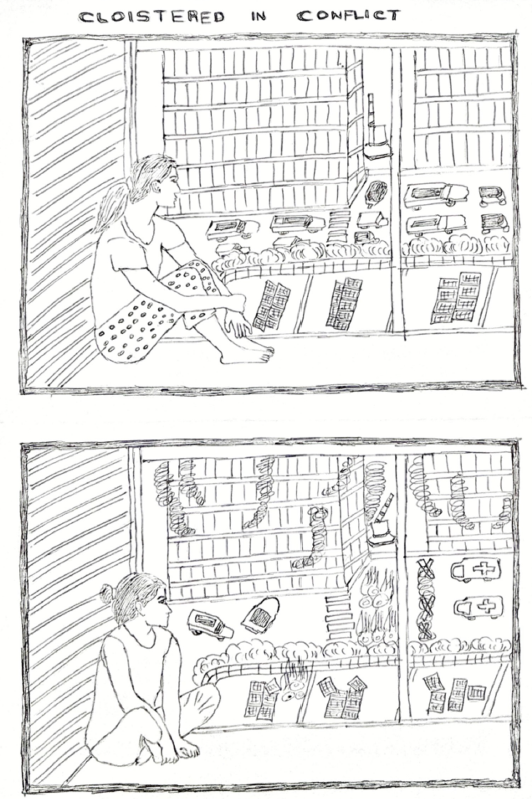
My hotel window became both a refuge and a reminder of my helplessness. Through it, I watched Dhaka’s surreal transformation: first bustling with life, then eerily still, and finally cloaked in smoke.
Below is an illustration I created, depicting the view from my window during the fieldwork. The two panels show a stark contrast: in one, life unfolds busily with rickshaws, vendors, and traffic filling the street—a typical day in Dhaka before the conflict. On the right, the street lies empty and silent, the calm punctuated only by the distant shadow of unrest.
On our first day in the city, my colleague took a photograph of a vibrant street filled with rickshaws, vendors, and pedestrians. A week later, she captured the same street again. This time, it was deserted, the silence punctuated only by the distant crack of gunfire. I created the illustration below based closely on those photographs. The two panels show a vivid contrast: one side bursts with the life of a typical day in Dhaka, while the other reveals a deserted, silent street marked by the shadow of unrest. Together, the illustrations tell the story of a city’s descent into chaos, mirroring the heavy ethical questions we were forced to confront as observers caught between witnessing and acting.
They reflect my position: present, yet paradoxically untouched.
Ethical Dilemmas
As the crisis deepened, I found myself grappling with questions I had not anticipated. Conflict researchers often speak of the tension between witnessing and acting and suddenly I felt this tension deeply. My privilege as a researcher—the option to leave anytime if things worsened—stood in stark contrast to the reality faced by those outside. The communities I had come to study were enduring a crisis that I could only partially comprehend from my limited vantage point.
Fieldwork in a politically charged environment was a confrontation of my own insulation. As a qualitative researcher, I was accustomed to immersing myself in others’ worlds; it was a reminder that proximity does not equal vulnerability.
Keeping a field journal became my lifeline. What began as a fieldwork diary transformed into a space where I poured out my fears, my questions, and ethical dilemmas. I wrote candidly about the uncertainty of my role, the privilege of my safety, and the unsettling reality of a country unravelling around me.
Resilience in Crisis
The days stretched long. What kept me grounded was staying connected to my family, colleagues, and my journal whenever possible,
Fieldwork is never a detached or purely observational act. As researchers, we inevitably become part of the narratives we seek to document, carrying the weight of the ethical dilemmas and emotional burdens that come with the work. In Dhaka, this entanglement became impossible to ignore. Each decision—to remain indoors, to prioritize safety, to keep documenting—was fraught with complex considerations.
Lessons From Dhaka
The experience taught me that resilience is not the absence of vulnerability but the determination to persevere despite challenges and fears. I came to understand that the narratives we aim to tell are deeply intertwined with our own positionality, privilege, and limitations.
As I left the city, I carried with me the weight of the questions about power, positionality, and the ethics of presence. Fieldwork is often described as a process and a journey to uncover truths about issues. But sometimes, it reveals as much about ourselves—the contradictions we grapple with and the questions we cannot yet answer. Some truths are easier to record than to carry.
Bio
Dr. Monisha Lakshminarayan is a Principal Consultant with the MERL team at Athena Infonomics. She leads a portfolio of multi-country trauma-centered evaluations and evidence synthesis projects at Athena. She obtained her PhD in Social Work from Delhi University.