
Encountering Privilege: Accessing the World of the Middle Class in Shimla
Ravi K. Bharmouri
PhD Research Scholar, Jawaharlal Nehru University, Delhi
The scholarship on educational research tends to ‘study down’, seeking to explain disadvantage rather than explaining the mechanisms of advantage (Ball, 2015). In the context of India, educational inequality research has primarily focused on disadvantage linked to structural location, while social class and educational advantage receive far less attention (Nambissan, 2009). Against the grain, my research focuses on middle-class families as the primary object of study, particularly examining parents’ career aspirations, strategies, and practices in relation to their children’s early schooling education. The Indian middle class heavily relies on education to secure mobility and reproduce its social position, making it a critical site of analysis. Following Nader’s (1972) call to ‘study up’, this research argues that examining middle-class privilege and its mechanisms of reproduction through the site of education is essential for understanding how educational inequalities are perpetuated in the regional context.
My research field site is Shimla, the capital of Himachal Pradesh, located in North India. In my study, the two chosen schools are well-reputed and popular among middle-class parents in Shimla, as they serve as a cultural marker of the middle classes in India, distancing them from the lower classes in the city. Both schools are affiliated with the CBSE board and are private, English-medium institutions. One is a convent school established 100 years ago, while the other was established in the post-independence period and is marked by the influence of Vedic values. The fees at both schools are approximately five to seven thousand per month, along with additional annual charges at the start of each academic session.
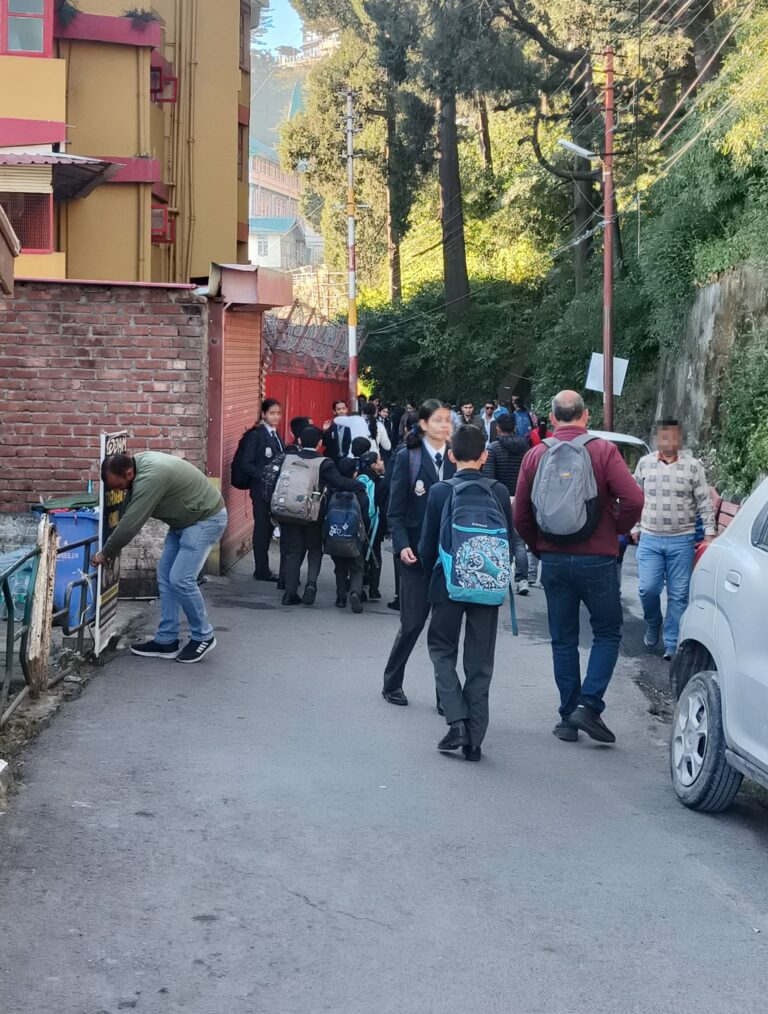
My study primarily employs a qualitative methodology, using methods such as interviews, observations and focus group discussions to collect data. I carried out semi-structured interviews with parents, teachers, and administrators. The interviews were conducted over a period of several months, from July to November 2025. Schools are the primary entry point for accessing respondents. I conducted most of the interviews outside the schools on benches, except for a few conducted on benches along Mall Road. I conducted surveys and interviews without participating in the everyday affairs of middle-class families, nor did I participate in school activities. Needless to say, this raises concerns about the limited intimate collection of the data in the field (Srinivas et al., 2004).
Most respondents were women, as they are primarily involved in their children’s education. In terms of caste composition, except for a few Dalit respondents, the majority belonged to privileged castes. Although the presence of Dalits in the district of Shimla exceeds one-fourth, these reputed schools are not spaces intended for them.
It has been observed in the field that most of the reputed private English medium schools in Shimla are demographically dominated by Brahmin and Rajput families, with only a few Dalit children studying there. In addition, even in cases where a few Dalit children are enrolled, they often change or adopt privileged caste surnames to protect themselves from caste discrimination, which reflects the persistent caste realities in a developmental state like Himachal Pradesh. Untouchability is explicitly practised, and the role of the ‘Devata’[1] institution in reinforcing caste hierarchies is significant in some parts of Himachal Pradesh, including Shimla (see Jodhka, 2015). Devata institutions hold traditional power and regulate the social life of the people. The respondents, many of whom maintain stronger ties with their villages, fear the Devata, whose presence strongly shapes their everyday interactions with other marginalised communities, especially Dalits. Thus, caste emerges as a powerful identity that shapes the researcher’s relations with the respondents.
Navigating Caste Identity Among the Middle Class: Some Instances from the Field
As an outsider to their social world, and given the ambiguity surrounding my caste identity, participants may have exercised restraint in sharing information, particularly regarding the collection of intimate data. In this context, it is essential to navigate one’s caste identity with sensitivity. If I were to reveal my caste location in the field, coming from one of the shepherding communities of Himachal, it might damage the rapport I have built with respondents from privileged communities.
Once, a respondent agreed to participate in an interview and exchanged contact details with me. The following day, he mentioned that he had looked me up on Truecaller[2] and noticed that I was not using a surname. This led me to reflect on my caste positionality from the outset, and I can see the curiosity about my caste identity among the respondents. At the same time, they seemed aware of the legal intricacies surrounding caste and therefore avoided asking directly. However, based on the way I questioned them about caste identities and inter-caste relations, some privileged-caste parents attempted to make sense of who I might be. A few of them later shared with me that they had already assumed I belonged to their caste group. It would be sufficient to present one such instance here. This occurred during an interview when a woman from a Rajput family said with conviction, “You are also from the Rajput community?” (translated from Hindi to English). I found myself in a position where I could neither confirm nor deny this assumption. I responded with a slight smile and redirected the conversation to another topic.
At the same time, I realised the fact that carrying such an image among privileged-caste parents might negatively affect my interactions with respondents from marginalised backgrounds, mainly Dalits, in the field. I also did not want to lose the trust of privileged-caste communities, as that would limit my ability to probe further. For the most part, I avoided revealing my own caste location, since doing so could potentially damage the rapport I had built over the previous few months. As a result, navigating my caste identity proved to be a substantive challenge with methodological implications.
Accessing the Privileged Middle Class
Another aspect I would like to address is the issue of accessibility, which I flagged at the beginning. Accessing the world of privileged individuals is challenging, as they are often out of reach and do not want to be studied or become the subject of inquiry. After spending a few months in the field, I can confidently claim that it is not easy to work with even the middle classes, let alone the upper elite strata of society. It is difficult to build trust and a good rapport with them. They ask many questions, remain sceptical, and often ultimately decline the request to talk about their lives. This hesitation stems from the fear that their information could be used against them. They have organised their lives in such a way that they do not have any spare time to talk with anyone. In a way, these individuals are always in a hurry to catch up, and this politics of time has broader implications for researchers conducting studies with the middle class.
In the field, I regularly arrive in the morning, as school starts around 8:50 a.m. I would arrive early so that I could speak with the children’s parents and convince them to participate in an interview. Many initially said no; some of them said yes but later backed out, and only a few respondents ultimately participated in the actual interviews.
These experiences are constant for researchers working in the field. One such instance occurred while interviewing. There were around four or five benches entirely occupied by women who came each morning to drop off their children. I was sitting on one bench with two women, talking to one of them, while another woman intermittently offered her input, even though I had not asked her, as we had already scheduled her interview for the next day. When I asked about the family’s income and its sources, the respondent, the children’s mother, began making faces. Eventually, another woman sitting with us commented, “Are you a member of some organised online crime team, collecting systematic information about families?” The next moment, when I pulled my university ID out of my pocket, she jokingly said, “Many JNU students went to jail, but you don’t seem like one of them.” The following day, when I asked another woman for an interview, she refused it explicitly. This instance also reflects the media’s portrayal of the systematic stigmatisation of the premier institution, which has broader implications for researchers from the same university. Despite my prior explanation that I am a researcher and that this information was part of my study, such a comment was still made. This remark, along with the accompanying body language such as facial expressions and tone of voice, indicated their scepticism toward this kind of information gathering.
In sum, this piece reflects on methodological concerns in accessing privileged groups, including mistrust, time constraints, and the researcher’s ambiguous caste identity. In a caste society, navigating your caste identity with sensitivity is a crucial and essential component of doing fieldwork as a researcher. These field encounters demonstrate that studying the middle class is neither easy nor neutral, but essential for understanding how educational inequalities are sustained in the regional context of Shimla.
Bio: Ravi K. Bharmouri is a research scholar in sociology at Jawaharlal Nehru University, Delhi, working on the topic of Middle-class Parents and their Strategies of Privilege Formation. He has a Master’s in Sociology from the same institution and graduated from Himachal Pradesh University, Shimla. His research focuses on various aspects related to Caste and Class, the Middle Class and Education, Youth and Career Aspirations, and Tribal and Rural societies of Himachal Pradesh.
References
Ball, S. J. (2015). Elites, education and identity: An emerging research agenda. World Yearbook of Education 2015, 233-240.
Jodhka, S. S. (2015). Cast (e) on the Hill:’Divine’Power, Social Cohesion and Hierarchy in Himachal Pradesh. Economic and Political Weekly, 59-68.
Nader, L. (1972). Up the anthropologist: Perspectives gained from studying up.
Nambissan, G. B. (2009). The Indian middle classes and educational advantage: Family strategies and practices. In The Routledge International Handbook of the Sociology of Education (pp. 285-295). Routledge.
Shah, A. (2017). Ethnography? Participant observation, a potentially revolutionary praxis. HAU: Journal of Ethnographic Theory, 7(1), 45-59.
Srinivas, M. N., Shah, A. M., & Ramaswamy, E. A. (Eds.). (2004). The fieldworker and the field: Problems and challenges in sociological investigation (2nd ed.). Oxford University Press.
Endnotes
[1] Devatas are local deities, who reside in temples.
[2] Truecaller is a widely used application that helps identify unknown or unfamiliar callers.